
Query Fan-Out in ChatGPT and Gemini Across 6,352 Searches
We analyzed how two AI engines turn one question into multiple searches. ChatGPT explored more variations, while Gemini repeated a much more stable core.
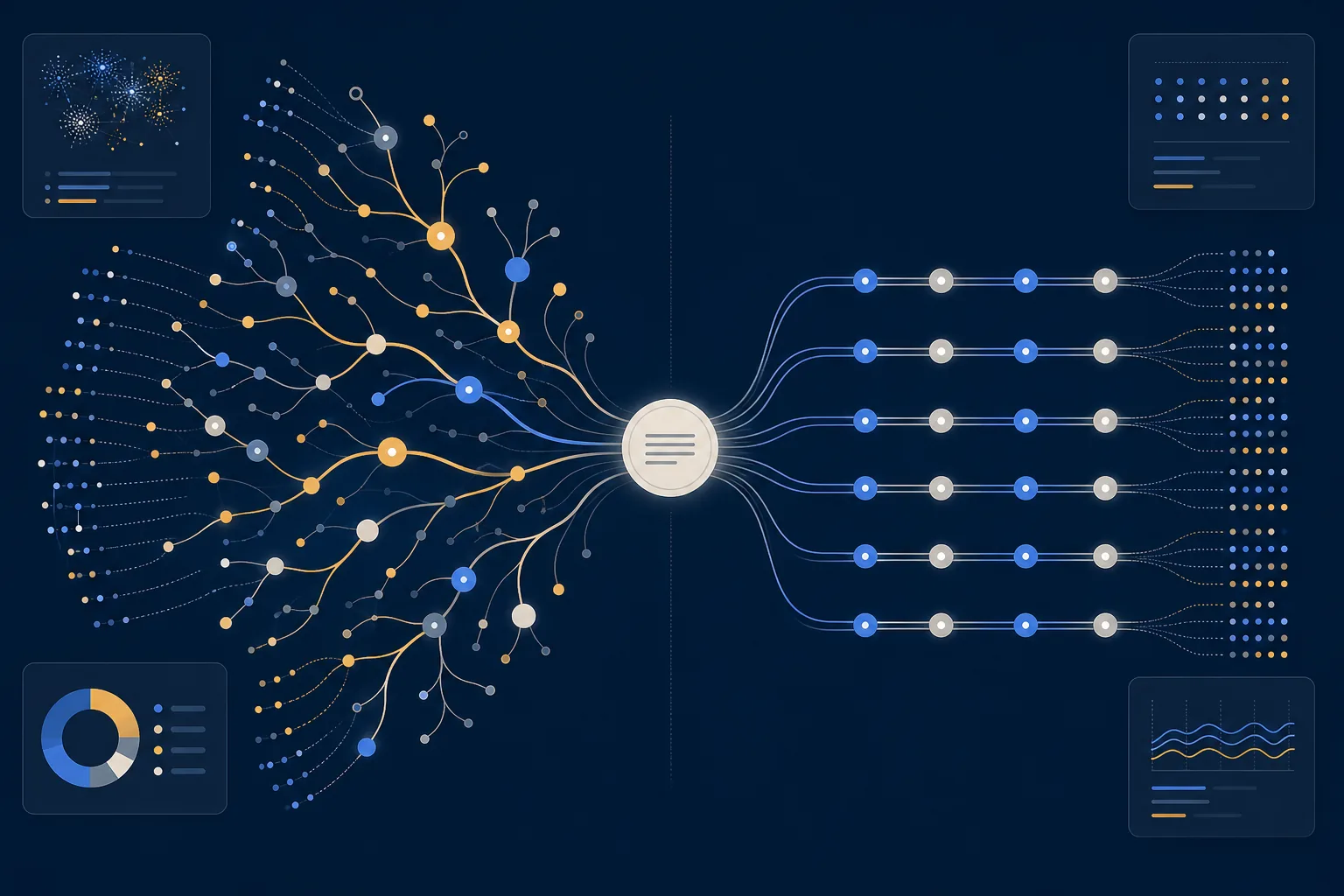
When someone asks an AI assistant to recommend a vendor, hotel or software product, the engine does not always work from that exact sentence. It may run several auxiliary searches, reorder terms, add a location, look for reviews or compare alternatives before composing its answer.
This process is called query fan-out. To see how it behaves in practice, Bee LLM analyzed 1,595 responses with recorded searches from ChatGPT and Gemini. We observed 6,352 real auxiliary query occurrences between June 23 and July 21, 2026.
The main finding
For prompts with at least five runs, 20.1% of ChatGPT query occurrences belonged to repeated phrasings. For Gemini, the figure was 84.1%. In this sample, ChatGPT explored many variations while Gemini reused a stable set of searches much more often.
What query fan-out means
Query fan-out is the decomposition of a prompt into several searches that help an engine retrieve and compare information. A request such as “which SEO consultant should I hire in Barcelona” can trigger searches about agencies, consultants for small businesses, audits, pricing, expertise or reviews.
For GEO, this changes the unit of work. One prompt is not one keyword. It can hide a small search network that determines which sources enter the final answer. Mapping that network reveals opportunities that a classic keyword tool cannot show.
The study data
| Metric | ChatGPT | Gemini |
|---|---|---|
| Responses with recorded searches | 990 | 605 |
| Auxiliary query occurrences | 4,739 | 1,613 |
| Average per response | 4.79 | 2.67 |
| Occurrences from repeated phrasings* | 20.1% | 84.1% |
| Maximum recurrence of one phrasing | 16 | 19 |
*Calculated only for prompt-engine combinations with at least five responses containing searches. A repeat requires the same normalized wording within the same prompt and engine.
ChatGPT opens more search paths
ChatGPT produced almost five auxiliary queries per response and a wide variety of phrasings. In the comparable cohort, only 8.1% of query types appeared at least twice. Those repeated searches accounted for 20.1% of all occurrences.
The pattern suggests broad exploration. For the same need, the engine changes modifiers, combines attributes and tries different routes. That broadens the set of pages that may become sources, but it also makes a single run an unreliable snapshot.
Gemini returns to a stable core
Gemini generated fewer queries per response, averaging 2.67, but returned to the same phrasings far more often. Among prompts with at least five runs, 51.2% of query types recurred and those recurring queries accounted for 84.1% of occurrences.
This creates a different opportunity. If an auxiliary search persists and the brand is absent from the sources that satisfy it, there is a specific gap to investigate.
The engines rarely match word for word
After normalizing capitalization, accents, punctuation and whitespace, we found just 26 identical queries shared by ChatGPT and Gemini for the same prompt. These matches appeared across 22 of the 75 prompts analyzed.
This measures textual equality, not semantic equivalence. Two differently worded queries may still express the same intent. Even with that caveat, the low exact overlap reinforces an important point: results from one engine should not be assumed to represent another.
Real examples of recurring queries
Recurring searches in the sample, shown without linking them to any account, included:
- “best holiday rental management companies Algarve Portugal”
- “mejores consultores SEO Barcelona para pymes”
- “agencia SEO Barcelona analítica marketing”
- “consultoría SEO auditoría SEO completa Barcelona”
These are not keyword recommendations for every business. Their value lies in showing how engines add category, location, audience and selection criteria to the original question.
What changes in a GEO strategy
- Measure repeated runs. One answer cannot reveal which searches are structural and which are one-off variations.
- Cluster by intent. Do not create a page for every wording. Group equivalent queries and build one strong answer for the cluster.
- Prioritize recurrence plus absence. Start with searches that recur where your brand or domain never reaches the answer.
- Analyze every engine separately. ChatGPT, Gemini, Claude, Copilot, Perplexity and AI Mode may rely on different retrieval paths.
- Connect content to measurement. After improving a page, check whether it enters the source set and whether the brand gains visibility for the original prompt.
This complements the work of understanding how LLMs choose sources and prevents GEO from becoming a factory of near-duplicate articles.
Methodology and limitations
How we calculated the results
We analyzed non-demo responses from eight accounts, 11 projects and 75 prompts recorded in Bee LLM from June 23 through July 21, 2026. We counted only responses with a non-empty auxiliary-search list: 990 from ChatGPT and 605 from Gemini.
To measure recurrence, we normalized capitalization, accents, punctuation and whitespace, then compared each query within its prompt-engine combination. The primary stability comparison is limited to prompts with at least five query-bearing responses.
The sample does not represent every country or industry. It mainly covers professional services, SEO, holiday rentals and adjacent categories. ChatGPT also recorded auxiliary searches in a larger share of responses than Gemini, which is why we compare averages and rates rather than raw totals alone.
These results describe behavior observed during this period. Retrieval systems change, and the data does not prove why an engine selected a particular query.
The opportunity sits between the prompt and the answer
Query fan-out exposes a layer that normally stays hidden. If a company tracks only the final answer, it knows whether it appeared. If it also observes the auxiliary searches, it learns which source set it is competing for and which intent it needs to satisfy.
The lesson from this sample is straightforward: covering a topic does not mean repeating one keyword. It means answering the network of questions each engine uses to construct its recommendation.
Frequently asked questions
What is query fan-out?
It is the process by which an AI engine turns one question into several auxiliary searches to gather, compare and synthesize information before answering.
How many search queries does ChatGPT generate?
In this sample, ChatGPT responses with recorded queries generated an average of 4.79 auxiliary searches. This is not a fixed number and should not be extrapolated to every response.
Do ChatGPT and Gemini search in the same way?
Not in the observed data. ChatGPT used more variations, while Gemini repeated a stable core of searches more often. They shared only 26 exact normalized phrasings for the same prompt.
See how AI engines find your brand
Request a visibility audit and receive a report covering your presence, competitors, sources and opportunities across nine AI engines.
Request a free auditKeep reading: AI visibility metrics · how ChatGPT Search works.